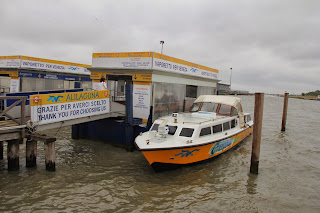
 |
| Our "taxi" from the airport to "downtown" Venice. |
Direct air service from Cagliari
to Venice made
the next stage of our trip easy. We left
behind sunny Sardinia and our good friend Rosa to fly to Venice’s Marco Polo
International Airport, which as most of you know, is on the mainland, then found
our pre-paid vaporetto, a motor boat taxi, which took us across
the choppy Laguna Veneta into Venice. The drizzly, grey weather was Joan's idea of perfect weather for romantic Venice.
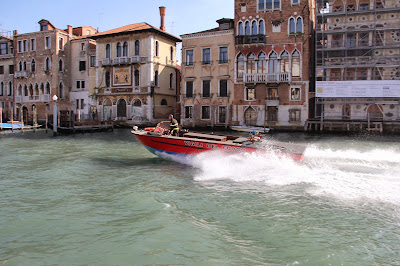 |
| Fire department boat on the Grand Canal in Venice |
She had been to
Venice
in the 1970s, but this was the first time for Dane. We all know that
Venice is about water. There are gondolas that take tourists for a
ride, and of course there is the question about how rising water levels will
affect the historic structures. Because
he had never really thought it through, it never occurred to Dane that
everything had to use the water to get around.
Dirty hotel laundry – there was a boat for that. Trash hauling, either construction or
household debris – there were boats for that.
 |
| The "UPS Truck" boat on the Grand Canal |
Package deliveries, shop deliveries – there were boats for that. Police, fire, ambulances – there were boats
for everything!
The only way to get around,
especially with any load, is by some sort of boat, and we were not prepared for
the delightful variety of working boats.
Mind you,
Venice
also has streets, or rather pedestrian lanes, of course with a lot of little
bridges to span the many canals. The
delivery men were adroit at using special hand trucks that had extra wheels in
front to master the stairs of the small bridges.
 |
| Package delivery boat with adapted cart on the right. |
The weather was just a little damp and rainy. We had left the sun behind in Sardinia where
it was still keeping the beaches company, but
Venice is all about water, so why should we
complain if some of it was airborne? We
did get some nice sunny days, so don’t feel badly for us, but our initial view
of
Venice was
quite soggy.
 |
| San Salute Church on our rainy arrival day in Venice. |
We stayed at the Hotel Campo Stefano, a small hotel beautifully located on Campo Santo Stefano, a piazza not far from
the
Academia Bridge.
If you look at the largest land mass of
Venice,
it looks a bit like a mitten grabbing a knob, the two separated by the
Grand Canal.
 |
| Map of Venice thanks to Lonely Planet |
Campo Santo Stefano is about the middle of the mitten’s thumb, near the Ponte dell'Accademia and a very
short walk to many sights. For longer ventures, we only had to walk a
short distance to a vaporetto stop on the
Grand Canal. Of course, it is very very easy to get lost in Venice. We did, often. Luckily, there are useful signs pointing to main areas like San Marco and Rialto, which were lifesavers for us!
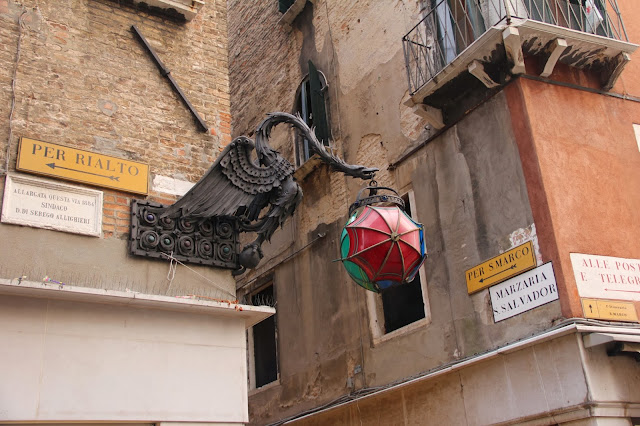 |
| Helpful signs directed us towards the Rialto and San Marco areas of Venice. |
There is very little modern building in
Venice.
We often thought of that phrase we learned in
New Orleans: faded grandeur.
 |
| "Faded Grandeur" in Venice |
 |
| Note water barrier on the door in this passageway. |
Not only the
Grand Canal, but also lots of tiny canals segment the
city and enable people and commerce to get around. We could see the preservation issues about
the encroaching water. At high tide many
of the pedestrian sidewalks bordering canals were awash in water.
Some buildings even had special
gates at their doors to keep the water out.
We also saw stacked table-like equipment in piazzas
and soon realized that in times of acqua alta (high water) these are deployed to make dry walkways.
 |
| High water in front of San Marco Cathedral in Venice. |
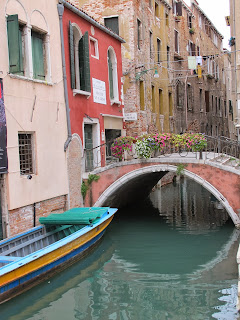 |
| A bridge over a small canal in Venice. |
We noticed that there were no railings or other barriers to
keep people from falling into the canals which were 6 feet and over
deep.
Apparently it was not much of a
problem; we could see that boat access to the canal banks was a vital part of
day-to-day life. The bridges come in all
sorts of designs and sizes. Using steps,
they all rise up to give clearance for the boats.
On the bridges there are walls or decorative
fences to deter stumbling into the drink.
It seemed there was always an OMG
view from atop the bridges.
Venice is a photographer’s dream; we tried to
sort through our large quantity of “bridge shots” to select a few for the best.
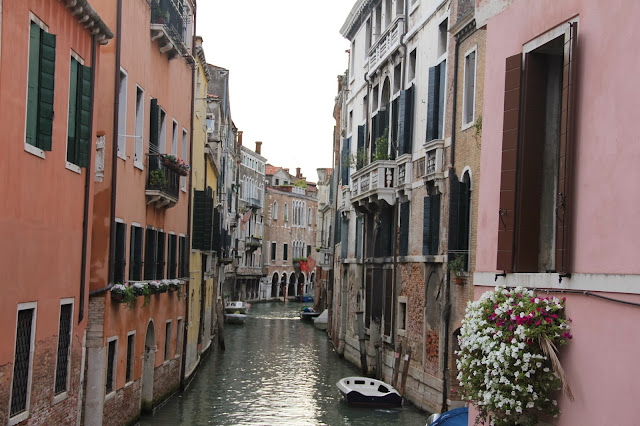 |
| A view from a bridge over one of the small canals of Venice. |
We are told that it was in
Venice that the phrase “spritz-o-clock” came into being, for the Aperol Spritz is certainly the most popular drink around 6 pm. We were sitting outside a little bar on a small street one afternoon enjoying our spritzers when a couple walked by, and the man asked his companion in English, “I wonder what are those orange drinks we see everywhere?” Joan piped up and said, “Well just come over here and we’ll tell you all about them.” They did, and she did! It occurred to us that we haven't given a
recipe for Aperol Spritz. Here's one we are enjoying now that we have returned:
In a large stemmed glass pour over ice cubes 3 parts Prosecco, 2 parts Aperol and top with a splash of soda or seltzer water. Garnish with half a slice of orange and maybe on a skewer a large green olive. Salute!
 |
| Bottles of Aperol glowing from a bar window in Venice. |
The site of this pleasant encounter was in an establishment,
unique to
Venice,
called a bacaro. Perhaps bacari are the
closest thing to English pubs in
Venice. They are usually small local gathering places
to drink and chat, and the food is a collection of cicchetti. The term cicchetti comes from a Latin word
meaning the smallest piece, and in this case is a small snack: a meat ball,
some olives or a deviled egg, displayed in a case by the bar. For the Italian language impaired like us,
these displays are handy, because we could just point to the plate that amused
us. We often made a decent meal out of a
collection of cicchetti, especially in the evening after an earlier big lunch.
 |
| A selection of cichetti at a bacaro in Venice |
For foodies, the guidebook to have in
Italy is
Slow Food Osterie & Locande d'Italia. The latest edition in English is 2007, but
many of the restaurants have been and will be around for years, not the
flash-in-the-pan tourist spots, but established purveyors of locally-sourced artisanally
prepared real food. One such place we discovered canal-side in a residential district was Ostaria da Rioba.
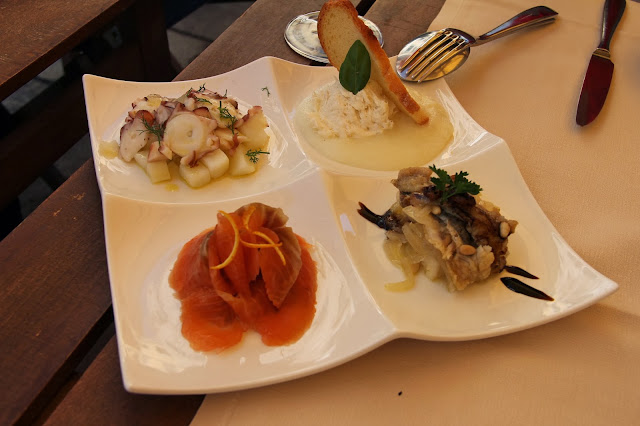 |
| Aperitivo of four Venetian fish at Ostaria da Rioba, Venice |
For apertivo we enjoyed a Venetian
sampler of four fish: salt cod on soft polenta, octopus slices and potato cubes
in EVOO, slices of smoked salmon and Venetian sweet and sour sardines.
 |
| Monkfish secondi at Ostaria da Rioba, Venice |
Primi were pappardelle with guinea fowl and plums and tagliatelle with fish, red pepper and squash blossom chiffonade. For secondi we had monkfish on a bed of fresh spinach topped with walnuts and pine nuts and duck breast with figs and a wine sauce. And for dessert, mango mousse with lime. Delizioso!
 |
| Duck breast with figs and a wine sauce at Ostaria da Rioba, Venice |
Another restaurant we enjoyed was recommended to us by Venetian
author and tour guide, Tudy Sammartini was
Osteria alla Bifora on Campo Santa Margherita.
Lit by beautiful Venetian glass chandeliers,
the menu featured a wide variety of cicchetti which made for a delicious
dinner.
 |
| Patrons enjoying ciccheti a Osteria al Bifora under Venetian glass chandeliers. |
Of course we had Spritz Aperols to accompany our feast!
 |
| Baccala (cod) with polenta, spada (swordfish) carpaccio, and sarda en sour (sweet & sour sardines) |
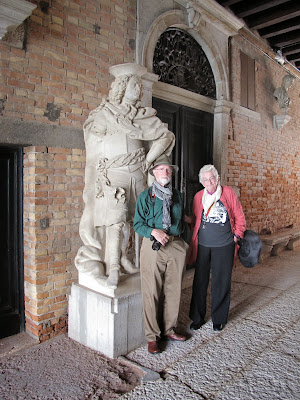 |
| Dane with Tudy Sammartini in the carriageway of her family's home on the Grand Canal |
Tudy Sammartini is a delightful character Joan stumbled upon
when she was searching for a guide to show us some gardens in
Venice. Tudy has been an official guide in
Venice since 1969, and is author of the trilogy of books
about
Venice’s
secret gardens, decorative floors and views from its bell towers. She comes from an established Venetian family
and has designed and installed both public and private gardens. Her English is excellent (though she smokes like
a chimney). She gave us an incredible private
tour, including places to which visitors do not have access, but Tudy knew the
owners and designed these spaces.
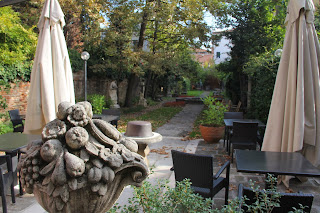 |
| One of the gardens Tudy Sammartini designed in Venice |
Land is scarce in Venice,
so having a private garden is quite a luxury; it was a luxury for us to have Tudy spend a beautiful morning showing us her secret gardens in Venice.
We were extremely fortunate to be in Venice during the 55th Biennale. Venice offers a visual overload, great art
and intriguing architecture at every turn, but the Biennale tops it off with a
large array of contemporary art, often in unusual locations throughout the city
worth seeing in their own right but generally not open to the public.
 |
| A Biennale exhibit in a nearby Venetian villa not usually open to the public. |

The
Venice Biennale has for over a century been one of the most prestigious cultural institutions
in the world. The history of the Venice
Biennale dates to 1895 when the first International Art Exhibition was
organized. In the 1930s new festivals were born: Music, Cinema, and Theatre. The Venice Film Festival in 1932 was the
first organized film festival. In 1980
the first International Architecture Exhibition took place, and in 1999 Dance
made its debut at the Venice Biennale.
 |
| A huge crane at the Arsenale. |
One of the most interesting and extensive venues of the Biennale
was at the
Arsenale – the historic boat yard and factory complex where the ships for the
once mighty Venetian navy were built.
This year the theme of the Arsenale Biennale exhibit was based on an Italian-American’s dream of constructing
a
Palazzo Enciclopedico, a museum where all knowledge could be displayed. This Biennale show brought together artworks
to found objects from the early 20th century to the present, and the factory
buildings and machinery were just as interesting.
 |
| Find the real people in this Biennale exhibit at the Arsenale! |
Of course there were other art museums to visit – trust Joan
to find art museums to, desperately, enlighten Dane. The
Peggy Guggenheim Museum was nearby our
hotel, over little bridges and through charming lanes, and certainly worth a
visit.
There was a very good selection
of contemporary art, particularly of Peggy's favorite cubists.
 |
| The Angel of the City by Marino Marini, 1948 |
We particularly enjoyed the show
The Avant Gardes of Fin-de-Siecle Paris. Of course we had to check out the
notorious sculpture in the canal-side courtyard!
Venice
is full of beautiful buildings. Perhaps most spectacular is the
Grand Teatro La Fenice (The Phoenix), a famous opera house which burned down in
1774. To make things interesting, a legal dispute broke out between the owners,
and when the dust settled, it was called it La Fenice in honor of having risen
from the ashes and legal tangles. In 1836 it was again stuck by fire and again
rebuilt. Then in 1996, you guessed it, yet another fire. A €90
million restoration lasted from 2001 to 2004. There was some controversy
as to whether they should build a modern theater or follow the 1836 plan – the
older version won, and now, wow!
 |
| Stage Door of La Fenice with boats loading equipment canalside. |
With
1000 seats, La Fenice is one of the most famous opera theaters in
Europe. We
arrived as the theater opened in the morning for self-guided tours, so enjoyed
it almost to ourselves, a special treat in crowded
Venice. And yes, there are even special boats to deliver the equipment to the theater!
Though we didn’t get to hear any opera, just a block away
from our hotel, the Chiesa di San Vidal hosts evening concerts. We heard
Interpreti Veneziani, a string
quintet, play Vivaldi’s Four Seasons.
 |
| Interpreti Veneziana string quintet, playing Vivaldi’s Four Seasons. |
The music was wonderful and the cello player was so dramatic we were almost in giggles by the end of the performance. Here's a video of the wonderful music.
After the concert we
repaired to a local outdoor café for drinks and met an English couple
who had also been at the concert. It was a great evening. In fact, we enjoyed evenings best in Venice, after the day trippers and cruise boat folks had left the city in peace and quiet for us.
 |
| Museo della Musica display of historic instruments in a beautiful old church. |
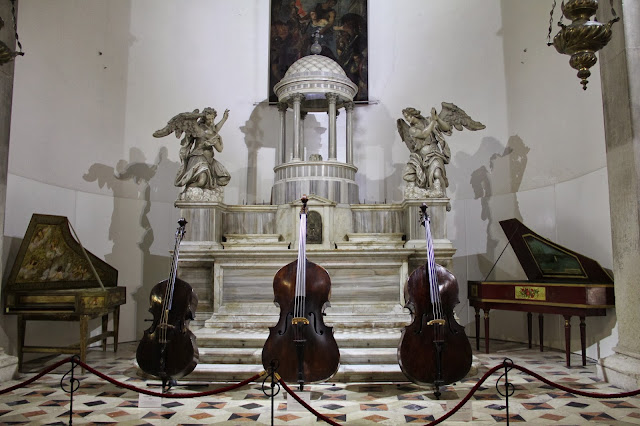
Nearby was also the
Museo della Musica, Campo San Maurizio
2761, a collection of
17th to 19th Century instruments and also the life history of
Venetian Antonio Vivaldi.
 |
| Pigeons, water and crowds, three ever present things on Piazza San Marco |
A visit to
Venice
is not complete without a trip to the famous
Piazza San Marco and its arcade
with fancy shops and restaurants, called the "Drawing Room of Europe" according to an unproven attribution to Napoleon. If all the crowds we saw were any indication, most of Europe was there while we visited!
 |
| Dressy waiters at Caffe Florian on Piazza San Marco, Venice. |
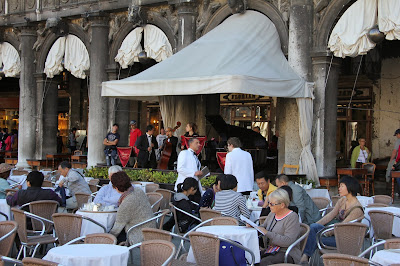
One of the highlights of
the arcades of Piazza San Marco is
Caffe Florian, an historic cafe with live music both day and night. The musicians and waiters are in black tie, so you don’t have to
dress-up. In the evening a couple strolling by might just break out into
a waltz.
 |
| Torre dell'Orologio, clock tower on Piazza San Marco, Venice. |
The
Basilica San Marco, at the head of the square, is flanked by
the
Torre dell’Orologio, a clock tower topped by two bronze figures striking a
large bell on the hour, and on the other side by the tall bell
tower of San Marco.
 |
| Chiesa di San Giorgio Maggiore as seen from across the lagoon. |
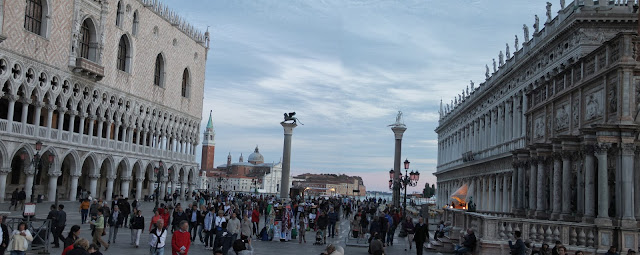
Just around the corner from the Piazza are the Palazzo Ducale
and a famous Piazetta view looking across the
Canale della Giudecca to the
Chiesa di San Giorgio Maggiore, "Big George's Church", the magnificent church across the lagoon.
 |
| View of the Piazetta between the Doge's Palace and Sansovino's Libreria looking towards the Lagoon. |
 |
| Illuminated interior of the Basilica San Marco, Venice, Italy. |
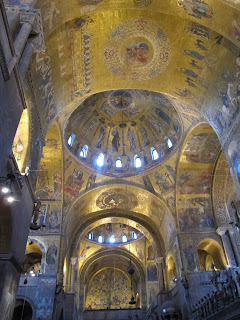
Of course we
toured the Basilica San Marco, enduring the long line and crowds. We were lucky to arrive just as the floodlights were turned on to illuminate the golden interior. A fee of a few euros was well worth it to get to see the
Pala d'Oro behind the altar, a fabulous Byzantine work of art.
 |
| Crowds examining the jewel-encrusted Byzantine Pala d'Oro behind the altar at Basilica San Marco, Venice. |
 |
| The lion of Venice statue on the Doges Palace in Venice. |
 |
| Entrance to the dungeons of the Doge's Palace, Venice. |
The other, surprisingly less crowded, "must do" is the Palazzo Ducale or Doges' Palace, with its fabulous meeting rooms and scary dungeons and of course the famous “
Bridge of Sighs”.
 |
| Cuba's entry in the Venice Biennale, cages of twittering videos. |
At the other
end of the Piazza from the Basilica is
Museo Correr, the city
museum of
Venice
which we also enjoyed, along with its special exhibit on the English sculptor
Coro and the Cuban
exhibit for the Biennale.
 |
| Dane taking a photo of the Grand Canal from the Ca' d'Oro. |
Joan also dragged Dane to the
Ca' d’Oro (Golden House – so
named for the gilt and polychrome once on its walls) on the Grand Canal, one of
the oldest palazzi in
Venice,
built in 1430. The last owner (1894) was an avid art collector, and left
his collection for the formation of the museum. We struggled, but finally found the
Ca' Pessaro, a wonderful gallery of international modern art, in another waterfront palazzo.
 |
| Ca' Pessaro art museum entrance. |
One of our most interesting dining experiences we owed to
our good friends and long-time Queen
Victoria
guests, Michael and
Martha Liscano.
They told us of a great restaurant on an out-of-the-way street. We went
to find it, scouring the area but came up blank. Joan was inspired to ask
at a little hotel in the neighborhood, and not only did the clerk speak good
English, but he knew all about the restaurant, “Oh, they’ve changed their name
and moved, same folks same food,” and he gave us directions; it was
nearby. Well, the Trattoria Antico Calice was charming, and when our eyes
adjusted, we noticed that it was full of gondoliers!
Joan felt right a home since she was wearing her black
and white striped shirt. The food was worth the
hunt. We had a simple insalata mista, house-made pasta with fish, olives,
capers and tomatoes, but the most interesting dish was the fish lasagna, which
Dane hopes to replicate someday.
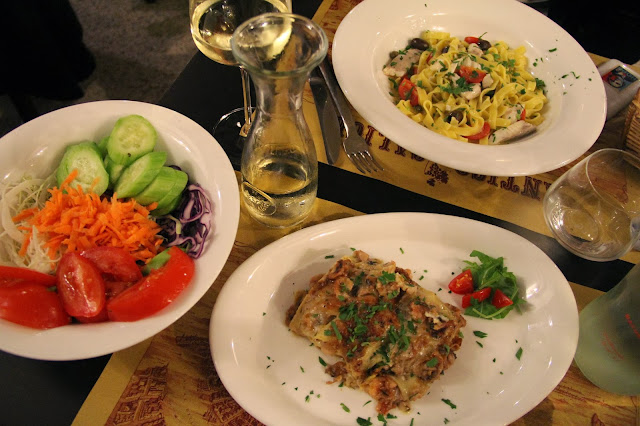 |
| Insalata mista, seafood lasagna and pasta with fish at Trattoria Antico Calice, Venice. |
As we were having our meal,
in walked Cella, a friend from the Pennsylvania Horticultural Society, and we
had a nice chat with her, proving once again that it is a small world!
 |
| Tiramisu at Ai Cugnai restaurant in Venice, Italy. |
We enjoyed several traditional Venetian specialties besides
the cicchetti. Joan enjoyed fegato alla
Veneziana (calves liver) at a nearby little café Ai Cugnai on our first night,
a rainy windy grey day when something warm appealed. Dane enjoyed squid with black ink sauce. We sipped limoncello while we shared a
tiramisu for dessert.
Another time we opted
for a Martini Rouge and a Cinzano Spritzer instead of our usual Spritz
Aperol.
 |
| Tagliatelle with scallops and pistachio pesto in Venice. |
We found yet
another gelateria artisanal where we enjoyed conos of special chocolate,
fig/walnut and dulce de leche gelati. And
let’s not forget pasta! Dane enjoyed
tagliatelle with scallops and pistachio pesto while Joan had ravioli with
shrimp at Osteria Al Ponte “La Patatina”.
Another restaurant Martha
& Michael recommended was Ristorante Cantionone where we
had fabulous gnocchi with gorgonzola and walnut sauce and a great little fennel
seed cracker,
taralli al finocchio.
 |
| Dane sharing his pizza with pigeons. |
Our food experience was not just about trattoria and
osteria, though. One day we were planning a nice evening meal so we
joined the touristy crowds and had a slice of pizza at a streetside stand,
joined by the ever-present pigeons!
Venice has a very well-known mercato
del pesce, fish market, near the
Rialto bridge. It is an open air market, under tents, unlike the market in
Sardinia, where the displays were awesome. We had seen the names and words on menus, but it was more fun to see the fish at the market thus be able to put a name to a (fish) face.
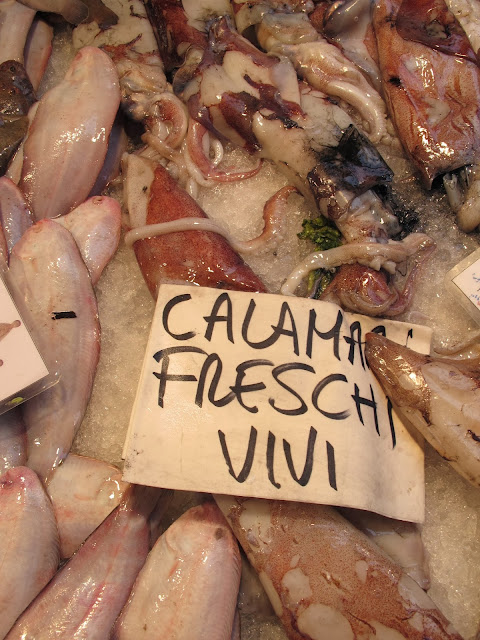 |
| Fresh Live Squid at the Rialto Market in Venice. |
Dane has the opinion that prior to the 1800s, wherever in
Europe there were wealthy merchants, there were
indulgences being paid to atone for their “sins of finance and commerce” and
thus a wealth of fine churches. Well,
Venice had a lot of
wealthy merchants and it has a fine stock of magnificent churches. Travelling
with Joan, Dane got to see a few of them. The
Basilica de Santi Giovanni e Paolo was one example.
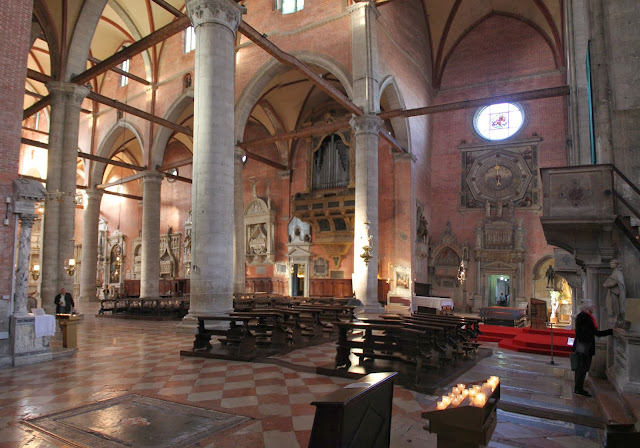 |
| Interior of the Basilica de Santi Giovanni e Paolo in Venice, Italy. |
 |
| Bell tower and east front of the Friari Church and Campo dei Friari, Venice. |
Of course Joan had to drag Dane to the
Scula Grande di San Rocco to see all the Tintorettos. Dane enjoyed walking around with one of the provided mirrors to comfortably see the beautiful ceiling paintings. We saw the tombs of Venetian sculptor
Canova and artist
Tintoretto at the brick Italian Gothic
Friari church which also had a Bellini triptych in the sacristy and a Donatello on a side altar.
Dane has a “rule” of no more than one museum and one church a day in
Italy, but there was such wonderful richness to see that we broke the rule regularly and he hardly ever complained.
One nice afternoon we took a vaporetto over to the
island of Murano enjoying the outside front seats
on the nearly empty boat.
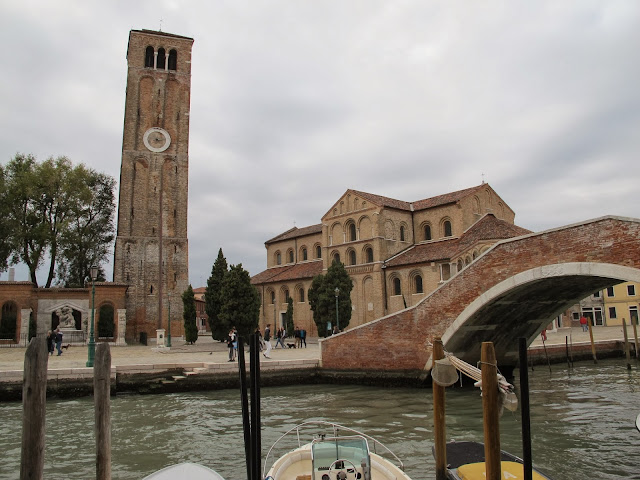 |
| Chiesa de Santi Maria e Santo Donato, Murano. |
There was a
charming Romanesque church,
Chiesa de Santi Maria e San Donato, and we visited the Museo del Vetro or Glass Museum of Murano and several shops selling beautiful hand-blown glass,
though we resisted buying any when we realized how risky it would be to travel
home with it.
 |
| It was hard to choose from among Eleni's beautiful earrings! |
Because of
the threat of fire, Venice’s glass works were moved to Murano centuries ago,
but another afternoon we walked to the Canareggio neighborhood of Venice, where
we found Miani, a little shop where the owner Elena Miani was making jewelry by
vetro a lume or lamp work, melting glass
rods into glass “pearls”. We stocked up on Christmas gifts, liking the idea of being able to talk to the craftsperson--it was not an Amazon experience.
 |
| Campo del Ghetto Nuovo in Venice. |
We also visited the
Ghetto, the old Jewish quarter of
Venice, where there was a
sobering monument. We were sorry we had
already eaten because there were some delicious looking cafes and bakeries in
the neighborhood.
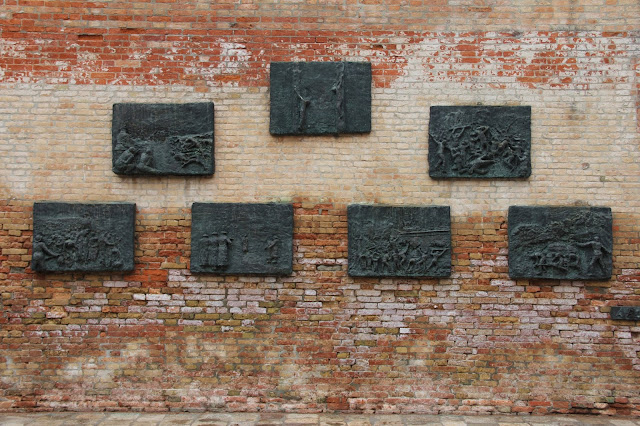 |
| Holocaust memorial sculptures by Arbit Blatas in Venice. |
 |
| Rooftop synagogue in the Ghetto of Venice. |
The Ghetto area included some of the "tallest" buildings in Venice, up to six stories, all apartment buildings of small units, sometimes topped by synagogues, because they could not be separate buildings in old Venice.
On our last night in
Venice,
we broke with our tradition of a late lunch and had dinner at a highly recommended osteria near our hotel in the Dorsoduro neighborhood,
La Bitta, which we had been trying to get into for several days, but found it was only open for dinner, and we needed reservations well in advance. Finally, success!
 |
| La Bitta was so small it was easy to miss. |
 |
| Arugula salad covered with thin slices of pear at La Bitta, Venice. |
One of the blessings of the restaurants we visited in
Italy is that
they are generally quiet-you can actually carry on a conversation-and La Bitta
was just such a place. We shared a salad of arugula, cheese, figs and
raisins covered with thin pear slices as an antipasto.
 |
| Gnocchi with pumpkin and smoked cheese at La Bitta. |
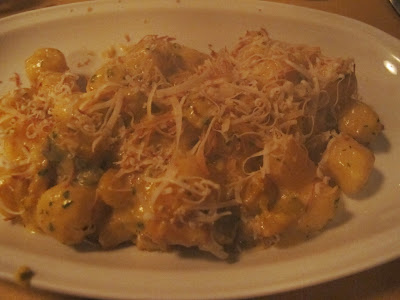
For primi we had gnocchi with
pumpkin and smoked cheese on top and tagliatelle with a chicken ragout. Rather unusual for a Venetian restaurant, La Bitta does not offer any fish dishes on its menu, but instead specializes in meats and vegetables.
 |
| Tagliatelle with chicken ragout at La Bitta, Venice. |
Secondi were stewed rabbit with mashed potatoes and a pork fillet sautéed in
aromatic herbs.
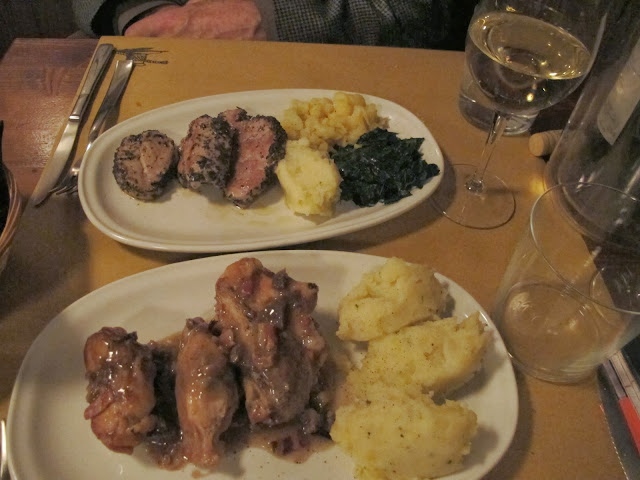 |
| Stewed rabbit and herbed pork fillet were our secondi at La Bitta. |
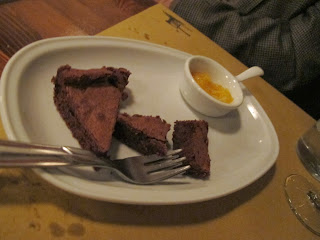 |
| Torta de chocolate with homemade marmalade at La Bitta. |
For dessert we shared a
torta de chocolate with homemade marmalade. It was a fine finale to our
week in Venice. We waddled home to our hotel!


